

The most common complaint I hear about Tucson is the awful condition of its roads, particularly the proliferation of potholes. Every time this subject comes up I recall that Tucson’s two main streets, Congress Street & Main Avenue, were not even paved until 1912-13; about the time Arizona became a state. From myriad accounts by travelers in those early years, any pavement was better than no pavement.
 Those of you who have read some of my brief histories on Southern Arizona Guide know that I sometimes refer to Tucson before the coming of the railroad in 1880 as “a dusty little Mexican village” or a “a dirty little Mexican village”. Even though Tucson legally became an American town with the Gadsden Purchase in 1854, most of the 600 or so residents at that time were Mexican and Papago (now known as the Tohono O’oohdam) Indians. At that time, the biggest barrier to Anglo settlement was the negative attitude of certain Apaches, among them Geronimo. Even when the Southern Pacific steamed into town, Tucson’s population was only about 7,000.
The roads were very dusty in the dry seasons and knee deep in mud during the wet seasons. Because the dust and mud were mixed with the overpowering stench of urine and manure from all the livestock, no one would have described our fair city as “a mecca for sun-worshiping tourists”.


In 1858, Phocion Way from Ohio was an employee of the Santa Rita Mining Company who arrived in Tucson via the San Antonio and San Diego Mail Line.
“There is a small creek [that] runs through town. The water is alkaline and warm. The hogs wallow in the creek, the Mexicans water their asses and cattle and wash themselves and their clothes and drink water out of the same creek. The Americans have dug a well and procure tolerably good water … which they use.
There is no tavern or other accommodation here for travelers, and I was obliged to roll myself in my blanket and sleep either in the street or in the corral, as the station house has no windows or floor and was too close and warm. The corral is where they keep their horses and mules, but I slept very comfortably as the ground was made soft by manure. I would rather have slept in the street as a great many natives do, but it is hardly safe for a stranger. Someone might suppose that he had money about his person and quietly stick a knife into him, and no one would be the wiser – there is no law here, or if there is, it is not enforced. Might make right.”
In the 1860’s, J. Ross Browne was a well-known Eastern writer who came through Tucson on a stagecoach headed west.
“(Tucson is ) a city of mud boxes, dingy and dilapidated, cracked and baked into a composite of dust and filth; littered about with broken corrals, sheds, bake ovens, carcasses of dead animals, and broken pottery. The best view of Tucson is the rear view on the road to Fort Yuma.”
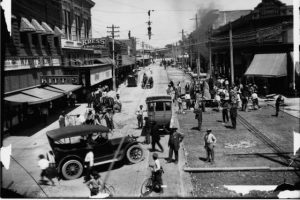
I’m reminded of this picture of Tucson every time I drive about the heart of the city trying my best to avoid the potholes. Not only could it be worse; it was.
But now that we have our modern streetcar, Downtown is much better. Thankfully, unlike its earliest incarnation, the new streetcar isn’t pulled by mules.
Note: before service began on Tucson’s Modern Streetcar in July, 2014, the City had electric streetcars. The old streetcars were discontinued at mid-night, December 31, 1930 in favor of city buses.
For more histories about Tucson and Southern Arizona, go to SouthernArizonaGuide.com > Local History.


